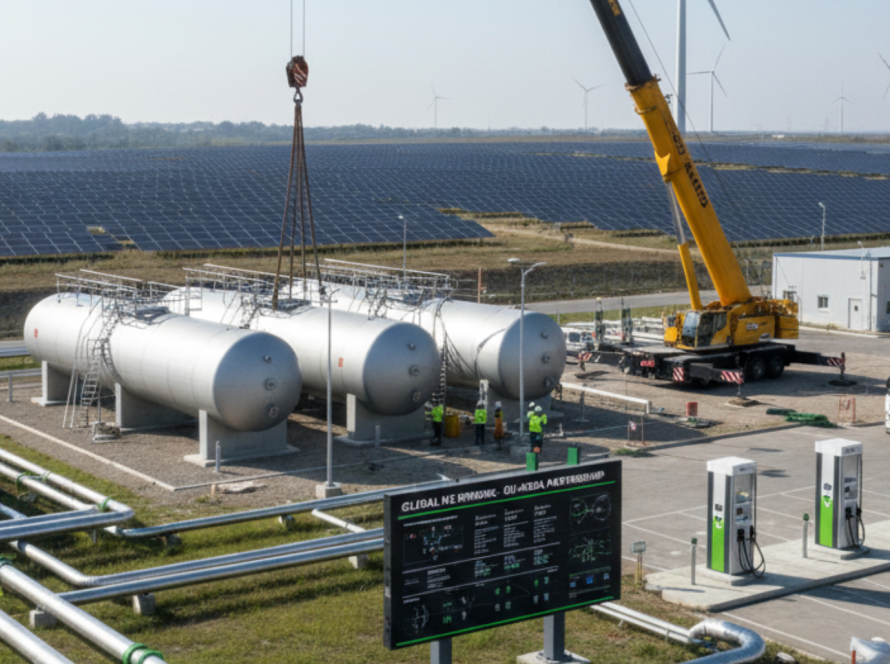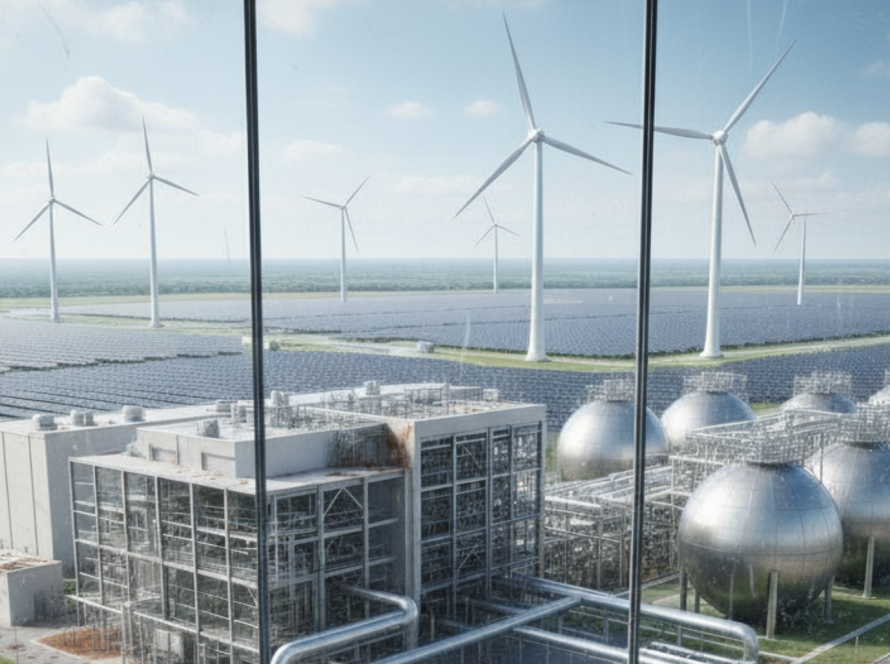
Green hydrogen has moved beyond speculative promise. In 2026, it stands at the threshold of commercial relevance-reshaping how governments, industrial operators, and capital markets approach deep decarbonization. Produced through renewable-powered electrolysis, green hydrogen offers a zero-carbon pathway for sectors where electrification alone is insufficient, including steel, chemicals, shipping, aviation, and grid-scale energy storage.
After years marked by high costs, delayed final investment decisions, and fragmented policy frameworks, the sector is entering a more disciplined phase. The global clean hydrogen pipeline now exceeds 1,500 announced projects, with more than 500 backed by committed capital. What distinguishes 2026 is not ambition, but execution.
For C-level executives, green hydrogen is no longer a question of “if,” but where, when, and at what scale.
Technology Maturity: From Experimentation to Industrial Logic
At the core of green hydrogen production is electrolysis-splitting water into hydrogen and oxygen using electricity. Three technology pathways define the current landscape:
- Alkaline electrolyzers (ALK) dominate today’s market due to cost efficiency and industrial maturity, particularly in China, where they account for the vast majority of deployed capacity.
- Proton exchange membrane (PEM) systems offer operational flexibility and faster response times, making them attractive for variable renewable inputs and mobility applications.
- Solid oxide electrolyzers (SOEC) remain early-stage but promise higher efficiencies at industrial scale when paired with waste heat.
The strategic breakthrough is cost. Electrolyzer prices continue to decline, while renewable power costs fall in parallel. In markets such as India, long-term projections now place green hydrogen costs near $2–3 per kilogram by 2030, approaching parity with fossil-based alternatives.
Emerging innovations-ranging from waste-derived feedstocks to AI-optimized energy integration-signal further downward pressure on costs. Yet executives should remain realistic: hydrogen remains energy-intensive, storage and transport are inefficient, and derivatives such as ammonia and methanol will play a central role in scalability.
Global Projects: From Announcements to Assets
The geographic spread of green hydrogen investment is widening, but activity is concentrating in regions that combine policy certainty, industrial demand, and infrastructure readiness.
- Europe is deploying green hydrogen primarily to decarbonize refineries and heavy industry, with large-scale electrolyser projects advancing in the Netherlands, Austria, and Germany.
- Asia has emerged as the volume leader. China continues to scale rapidly across hydrogen, ammonia, and methanol value chains. India is positioning itself as a long-term export and industrial hub, with multi-gigawatt projects tied to steel, fertilizers, and transport.
- The United States is advancing integrated hydrogen systems supported by tax credits and regional hydrogen hubs, linking production with storage and end use.
- Latin America is leveraging low-cost renewables to enter green hydrogen and ammonia exports, particularly in Brazil and Uruguay.
The critical shift is that projects are now under construction, not just on paper. This marks the transition from policy-driven ambition to balance-sheet reality.
Capital Flows and Corporate Commitment
Investment momentum in green hydrogen has accelerated sharply. Globally, committed capital exceeds $100 billion, with additional trillions identified as addressable opportunity through 2035.
National programs-such as India’s Green Hydrogen Mission and European funding mechanisms-are crowding in private capital. Corporations are no longer engaging purely through pilot projects; they are securing long-term offtake agreements to hedge future carbon exposure and supply-chain risk.
For executive leadership, hydrogen investment is increasingly a strategic hedge:
- Against carbon pricing volatility
- Against fossil fuel import dependency
- Against future regulatory tightening
Those entering early gain optionality in pricing, infrastructure access, and policy influence.
Know about: Europe Takes a Leap in Hydrogen-Powered Aviation Testing
Policy Alignment and Market Discipline
Policy remains the single most decisive factor in hydrogen economics. Incentives, carbon markets, and procurement mandates are narrowing the cost gap-but discipline is increasing. Only a small fraction of announced projects reaches final investment decision, underscoring the need for realistic demand signals and bankable business models.
Governments are shifting from blanket subsidies to performance-linked mechanisms, rewarding scale, efficiency, and verified emissions reduction. This is a positive development for serious operators and investors.
Executive Outlook: Why 2026 Matters
Green hydrogen in 2026 is neither a silver bullet nor a speculative bet. It is a strategic enabler-one that complements electrification, supports industrial competitiveness, and anchors long-term decarbonization strategies.
The winners will not be those who announce the largest projects, but those who:
- Integrate hydrogen into real industrial demand
- Secure reliable renewable supply
- Manage capital discipline and technology risk
- Align with evolving policy frameworks
For the C-suite, green hydrogen now belongs in core strategy discussions, not sustainability sidebars.
Bottom Line
2026 marks the inflection point where green hydrogen shifts from vision to infrastructure. Costs are falling, projects are advancing, and policy alignment is improving. While challenges remain, the direction of travel is clear.
Green hydrogen will not replace all energy systems-but it will define the future of those that cannot decarbonize any other way.